Yohannes IV
When Tewodros (emperor from 1855 to 1868) died in 1868, three men emerged hoping to become the next emperor: Wagshum Gobaze Gebre Medhen of Lasta, King Menelik II of Shewa, and Dajazmach Kassa Mercha of Tigray. Wagshum Gobaze was the ruler of Amhara, Wag, and Lasta (Pankhurst, R. 1998, 162). When Tewodros was killed, Gobaze occupied Gondar and crowned himself Emperor Tekle Giyorgis II. No one took his coronation seriously because there was no abun (Prouty, C. and Rosenfeld, E. 1982, 169). The second aspiring man, Menelik, became prominent once he escaped from Tewodros’ imprisonment in 1865. After his escape, with the support of family and friends, he became the ruler of the province of Shewa. But it was the third man, the one who wanted the title the least, who became the next true leader of Ethiopia.
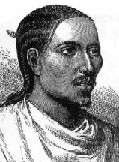
In early 1868, the British force seeking Tewodros’ surrender, after he refused to release imprisoned British subjects, arrived on the coast of Massawa. The British and Dajazmach Kassa came to an agreement in which Kassa would let the British pass through Tigray (the British were going to Magdala which Tewodros had made his capital) in exchange for money and weapons. Surely enough, when the British completed their mission and were leaving the country, they rewarded Kassa for his cooperation with artillery, muskets, rifles, and munitions, all in all worth approximately £500,000 (Marcus 2002, 71-72). This formidable gift came in handy when in July 1871 the current emperor, Emperor Tekle Giyorgis II, attacked Kassa at his capital in Adwa, for Kassa had refused to be named a ras or pay tribute (Marcus, H. 2002, 72). Although Kassa’s army was outnumbered 12,000 to the emperor’s 60,000, Kassa’s army was equipped with more modern weapons and better trained. At battle’s end, forty percent of the emperor’s men had been captured. The emperor was imprisoned and would die a year later. Six months later on 21 January 1872, Kassa became the new emperor under the name Yohannes IV (Zewde, B. 2001, 43).
The first major opposition the emperor faced was the expansionist Egyptians, who were highly interested in spreading their territory further south. The Sultan of the Ottoman Empire had ceded Massawa to the Egyptians in 1867. The Egyptians also had control of most of northern Sudan (Henze, P. 2000, 146-7). In 1874, an Egyptian army captured the Ethiopian cities of Bogos and Keren, both near the Sudanese border. The Egyptians had also occupied the port of Zula and all ports south of the Massawa, establishing an embargo preventing import of weapons into Ethiopia (Marcus 2002, 73-4). In 1875, the Egyptians took Harar. Yohannes had tried to appeal to European leaders but was completely ignored because Egypt was economically superior (Henze, P. 2000, 147).
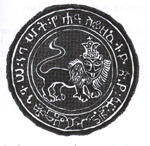
After Yohannes' peaceful attempts to resolve the situation failed, he declared war on the Egyptians on 23 October 1875. In November 1875, the Egyptian army met Yohannes’ well-prepared troops at Gundat. The Egyptian army lost one-third of its men, including their commander. The Egyptians returned 4 months latter with a better-equipped army, numbering 15,000 – 20,000 (Henze, P. 2000, 147-8). The three-day battle in March of 1876 in Gura left all but 500 Egyptians dead, wounded, or captured. Yohannes was also able to confiscate “12,000-13,000 Remington rifles, sixteen cannons, munitions, and other … booty.” (Marcus, H 2002, 75).
In the following years, both countries attempted to come to a diplomatic solution. Nothing came out of it for Ethiopia’s demands, that Egypt unoccupy land belonging to Ethiopia, was unacceptable to the Egyptians. At the same time, Egypt was breaking apart internally and in northern Sudan, which had been part of Egyptian territory, a Muslim Mahdist movement had broken out and replaced Egyptian authority as well as emerge as a threat to Ethiopia. The British came to Egypt’s defense in 1884 and made an arrangement between the three countries and a treaty was arranged, know as the Adwa (or Hewett) Peace Treaty. According to the treaty, Egypt would give back Ethiopian lands if Ethiopia assisted in the evacuation of Egyptian troops out of Sudan. After Ethiopia had carried out its part, Ethiopia was able to regain all former land except for its ports. (Zewde, B. 2001, 54-5).
With Egypt being in a such a weak position and Ethiopia not yet being strong enough to face a European power in war, the British were very concerned of French intentions in the Horn of Africa, for the French were already settled nearby in Tajura (in modern day Djibouti). The British figured that the best way to keep the French in check was to have a large presence in Ethiopia (Marcus, H. 2002, 82-3). So in early 1885, the British had convinced the Italians, a British alley, to take over Massawa. In doing so, it will soon be shown what the British had done towards Ethiopia was to take ‘one weak enemy [Egypt] for two strong ones, the Mahdist state and Italy.’ (Sven Rubenson qtd in Zewde, B. 2001, 55)
One of the first things that the Italians did in Massawa was to stop the import of weapons into Ethiopia from the Red Sea. By 1886, they were starting to penetrate into Ethiopian territory. They occupied two cities near Massawa, Saati and Wia, which according to the Adwa Peace Treaty, had been decided was part of Ethiopian territory. The following year, Ras Alula, the emperor’s chief commander, attacked the Italians and chased them away from the two cities (Pankhurst, R. 1998, 171-2). The Italians did not take this blow served by the Ethiopians lightly:
Both countries called upon Britain as an arbitrator, both believing they were in the right. The British needed Italy to counter French threat and thus proposed that Italy be allowed to occupy Saati and Wia. The British also proposed that Yohannes should publicly apologize to the Italians. A very angry Yohannes took some 80,000 men to Saati for once and all to finish the issue with the Italians. However, the Italians refused to come out of their fort to fight. Yohannes had no choice but to retreat because he was running out of food and supplies (Pankhurst, R. 1998, 172-3).
Both countries called upon Britain as an arbitrator, both believing they were in the right. The British needed Italy to counter French threat and thus proposed that Italy be allowed to occupy Saati and Wia. The British also proposed that Yohannes should publicly apologize to the Italians. A very angry Yohannes took some 80,000 men to Saati for once and all to finish the issue with the Italians. However, the Italians refused to come out of their fort to fight. Yohannes had no choice but to retreat because he was running out of food and supplies (Pankhurst, R. 1998, 172-3).
When Yohannes has signed the Adwa Peace Treaty to take back his land, the price to pay seemed small: assist in the evacuation of Egyptian troops out of Mahdist Muslim dominated area of Sudan. But now that Egypt did not have control of Sudan, the Mahdist Muslims were prepared to make Ethiopia punish for her interference. They began by attacking the western frontiers of Gojjam and Begemder. At the time, the emperor was preoccupied with the Italians at Saati and couldn’t be of any assistance. So it fell upon Tekle Haymanot, the ruler of Gojjam, to lead Ethiopia without the assistance of the emperor. Unfortunately, he was no match against the Mahdist Muslims and they inflicted heavy loses upon his army. He could not do anything as they marched on Gondar in 1888 and burned the city down. The Mahdist Muslim threat was temporarily suspended only once the emperor had called upon Menelik to defend Gojjam and Begemder. When Menelik was returning to Shewa after his campaigns in Begemder and Gojjam, him and Tekle Haymanot, who had been rivals beforehand, forged an agreement to work together against the emperor.
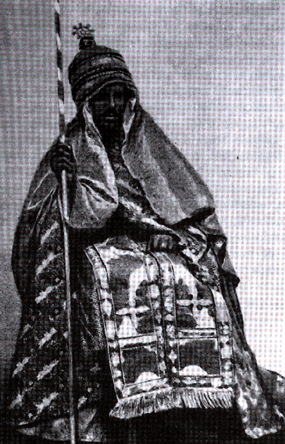
When Yohannes returned from his unsuccessful campaign in Saati, he invaded and ravaged Gojjam for Tekle Haymanot’s rebellious intentions (Henze, P. 2000, 158-9). After the ravage of Gojjam, Yohannes won back Tekle Haymanot’s loyalty and was preparing to attack Menelik in Shewa. Meanwhile, Menelik has made an arrangement with the Italians for a double attack on Yohannes. The Italians were going to attack from Massawa and Menelik from Shewa. The Italians has supplied Menelik with enough weapons to assure victory. But as it happened, the match between Yohannes and Menelik never occurred for once again when the Mahdist Muslims began to attack Begemder, the emperor abandoned his plans on attacking Menelik and ran off to face the Mahdist Muslims (Marcus, H. 2002, 86-7). This combat with the Mahdist Muslims, know as the Battle of Matamma, was to be Yohannes’ last: